
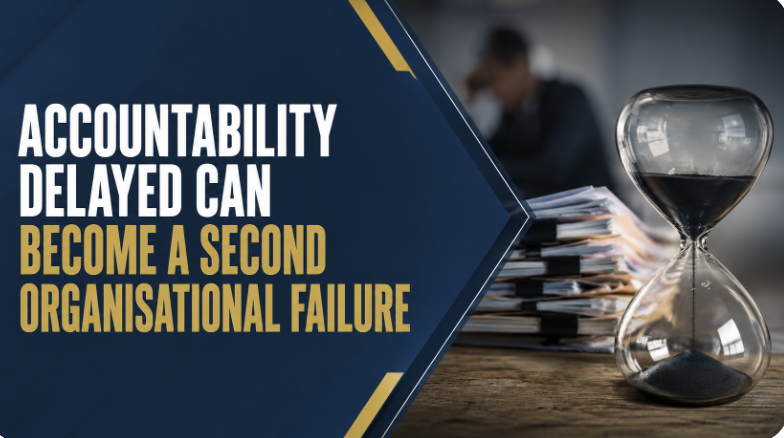
When a serious workplace incident occurs, organisations rightly begin an investigation.
Evidence is gathered, statements are taken and the review begins.
However, one of the greatest risks is not always the incident itself, it is what happens afterwards.
The Home Office has launched an end-to-end review of the police accountability system to examine how misconduct cases can become faster, fairer and more effective.
While the review focuses on policing, its lessons apply to every organisation responsible for investigating workplace incidents, violence, safeguarding concerns, restrictive interventions or serious complaints.
A well-designed review process is not just about determining what happened.
It is about protecting everyone involved while ensuring the organisation learns before another incident occurs.
Timeliness Matters
A timely investigation is not a rushed investigation.
Complex incidents require careful consideration of evidence, witness accounts, CCTV, policies, training records and, in some cases, expert opinion.
But unnecessary delay can create its own organisational risks.
Employees, managers, complainants and families deserve confidence that matters are being progressed fairly and efficiently.
Delay can weaken evidence, affect witness recollection, damage confidence in leadership and postpone important safety improvements.
Review More Than Individual Actions
Many investigations focus almost exclusively on the individual involved.
A good and structured review also examines the organisational systems surrounding the event.
Senior managers/review teams should ask:
- Were previous warning signs recognised?
- Was the risk assessment current?
- Were staff appropriately trained and supervised?
- Had similar incidents occurred before?
- Were concerns acted upon?
- Did organisational culture influence decision-making?
The objective is not simply to identify who made a mistake, or what caused the mistake, but to understand why the incident actually occurred.
Preserve Evidence and Learn Early
Evidence should be preserved immediately.
CCTV, incident records, emails, risk assessments and witness accounts can become less reliable over time.
Importantly, organisations should not delay obvious safety improvements while waiting for the final outcome.
Interim control measures, revised procedures, additional supervision or temporary risk reduction measures can often be introduced without prejudging responsibility.
Good Governance Requires Ownership
Every serious review should have:
- A clear owner
- Defined timescales
- Appropriate investigative competence
- Regular communication with those affected
- Documented actions
- and follow-up to ensure recommendations actually reduce risk.
The effectiveness of an investigation is measured not simply by the final report, but by whether meaningful organisational learning follows.
Leadership Questions
Senior leaders should ask themselves:
- Can we demonstrate that our investigations are both fair and timely?
- Are lessons implemented before another incident occurs?
- Did we examine organisational systems as well as individual conduct?
- Can we evidence improvements following previous investigations?
If these questions cannot be answered confidently, the review process itself may require review.
How NFPS Ltd Can Help
At NFPS Ltd, we help organisations strengthen the way they prevent, manage and learn from serious incidents.
Our work supports organisations to:
- Reduce violence
- Reduce restrictive interventions
- Reduce staff injuries
- Improve decision-making
- Improve governance
- Improve inspection readiness
- Improve organisational learning
- Create safer cultures
Through conflict management, restrictive intervention, trainer development, incident review, expert witness services and governance consultancy, we help organisations move beyond simply investigating incidents towards creating safer, more resilient systems.
About Trevel Henry
Trevel Henry is Director of NFPS Ltd, who has advised courts, tribunals and organisations across policing, education, healthcare, social care, security and the public sector.
His work focuses on helping organisations understand not only what happened, but why it happened and how future harm can be prevented.
The Home Office review serves as a reminder that accountability is not simply about reaching the right conclusion; it is also about reaching it in a way that is fair, evidence-led and timely.
Why – because when organisations delay learning, accountability itself can become a second organisational failure.
Contact us to learn more: https://nfps.info/