
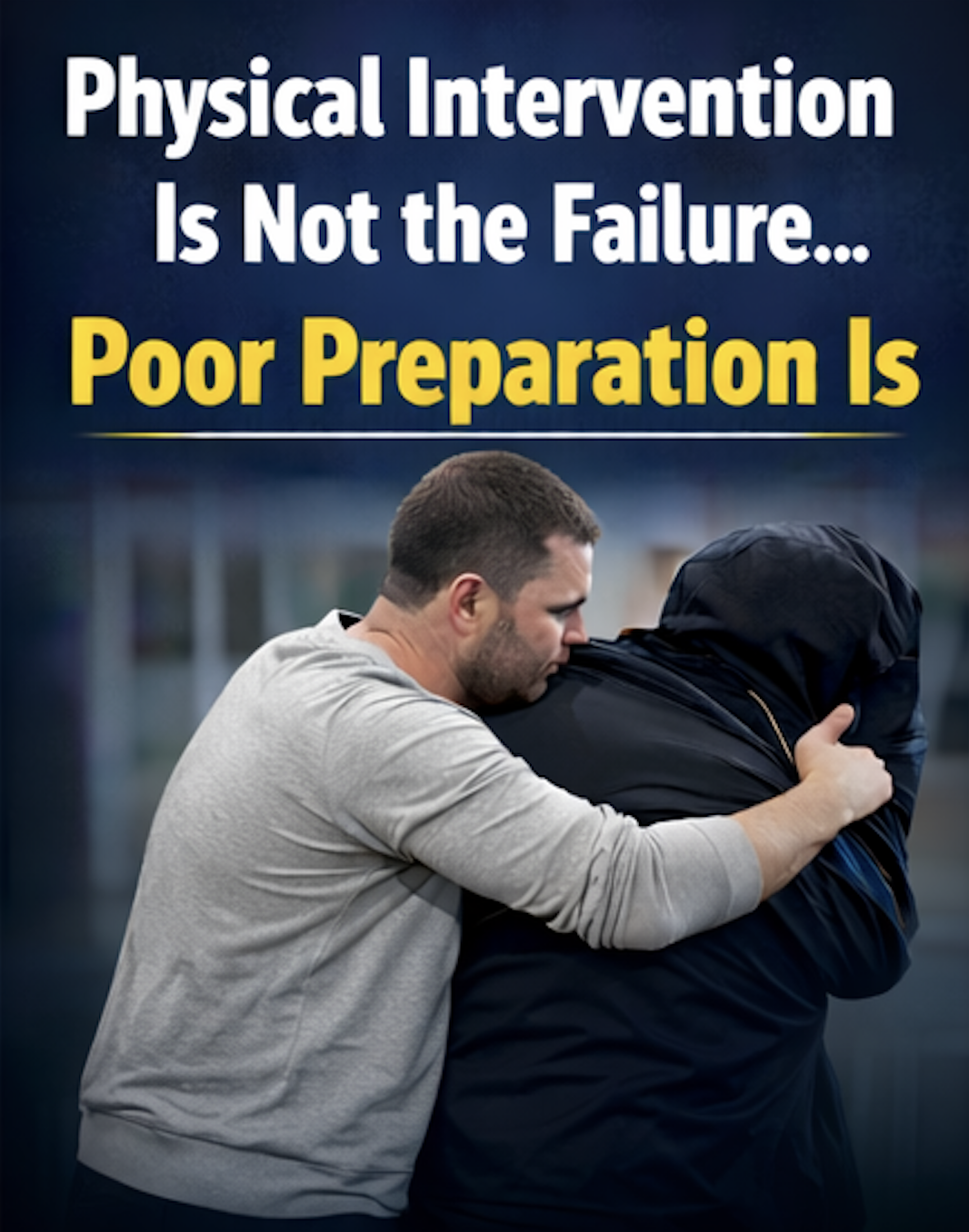
The problem is not physical intervention.
The problem is what organisations fail to put in place before intervention becomes necessary.
When an incident escalates to restraint, too many settings treat the intervention itself as the “failure point.”
The reality is that failure often occurs much earlier, at the level of leadership responsibility, operational planning, training standards, behavioural risk management, and organisational readiness.
If your systems are weak, your staff don’t “lose control.”
They inherit the consequences of poor preparation.
Physical intervention remains one of the most scrutinised components of frontline safety practice across education, care, health, and security environments.
Yet one misconception continues to undermine professional decision-making:
Restraint is not automatically evidence of poor staff behaviour.
More often, it is evidence of organisational exposure—where foreseeable risk was not properly assessed, managed, or prepared for.
From a professional and legal standpoint, scrutiny rarely begins with “Did restraint happen?”
It begins with stronger questions:
- Was the risk foreseeable?
- Was escalation preventable?
- Was the response proportionate, lawful, and defensible?
- Were staff trained to competence and not to attendance?
From a strategic risk perspective, physical intervention sits inside a wider framework of operational responsibility and legal duty, including:
- Duty of care
- Reasonable foreseeability
- Proportionate and justified response
- Competence-based training standards
At NFPS Ltd, we do not treat physical intervention as a “technique issue.”
We treat it as a leadership and governance issue because that is where accountability starts, and where failure often becomes predictable.
Why This Matters
When standards are misunderstood, the consequences are not theoretical.
They are operational, legal, and reputational and they typically land on the shoulders of staff who were never properly equipped in the first place.
When preparation is poor, organisations expose themselves to predictable outcomes:
- Escalation that could have been managed earlier
- Avoidable injuries to staff and service users
- Inconsistent staff responses across teams
- Collapse in confidence under pressure
- Complaints, investigations, and legal challenge
- Leadership accountability when warning signs were present
The reality is straightforward:
If violence and aggression are foreseeable in your setting, competence is not optional. It is a safeguarding requirement.
Poor preparation creates a culture where staff are left navigating complexity without clarity.
That is where unsafe decisions emerge.
Not because staff are careless, but because the organisation has not clearly defined what “good” looks like when pressure rises.
A physical intervention may be the moment everyone remembers.
But the organisational decisions that made it likely were already in motion long before the incident took place.
What Competent Practice Actually Looks Like
The benchmark for professional intervention is not “least restrictive on paper.”
The benchmark is defensible, competent practice in real conditions, supported by leadership oversight, policy, clarity and competent training.
Competent organisations treat physical intervention as part of a structured safety strategy, not a reactive response. That strategy includes:
- Clear thresholds for intervention based on risk, not emotion
- Behavioural risk assessment that reflects real-world complexity
- Defined staff roles and consistent expectations
- Training that develops judgement, not routine compliance
- Post-incident learning that improves systems, not just paperwork
- A proactive culture built around prevention, not denial
The standard is this:
Interpret the reality behind incidents.
- What should have been in place.
- What should have been foreseeable.
What competent decision-making should look like when control is being tested.
Because restraint isn’t the failure.
It is the moment your organisation’s preparation is exposed.
The Leadership Question You Cannot Ignore
If your current approach to physical intervention is primarily about reducing restraint numbers, you may be avoiding the real accountability question:
Are your staff genuinely prepared to manage escalation safely, lawfully, and consistently when behaviour deteriorates?
This is the point leadership teams must review:
- Does training develop real competence or just meet compliance measures?
- Do policies support professional judgement or create confusion under pressure?
- Are staff responses consistent, defensible, and safe across the workforce?
- Does preparation reflect what staff face day-to-day?
NFPS Ltd supports organisations to strengthen competence, reduce unnecessary risk exposure and establish professional benchmarks that stand up to scrutiny.
Not just during audits.
Not just during inspections.
But when it matters most, during and following real incidents.
Does your current training build confidence—or simply demonstrate compliance?
Want to know more – https://nfps.info/physical-intervention-trainer-course/
#WorkplaceSafety #DutyOfCare #LeadershipAccountability #RiskManagement #ViolencePrevention